Bus Fever Party!
- 4.1
- Rating
- 10.00M
- Installs
- Free
- Price

 Analysis by App-foxy
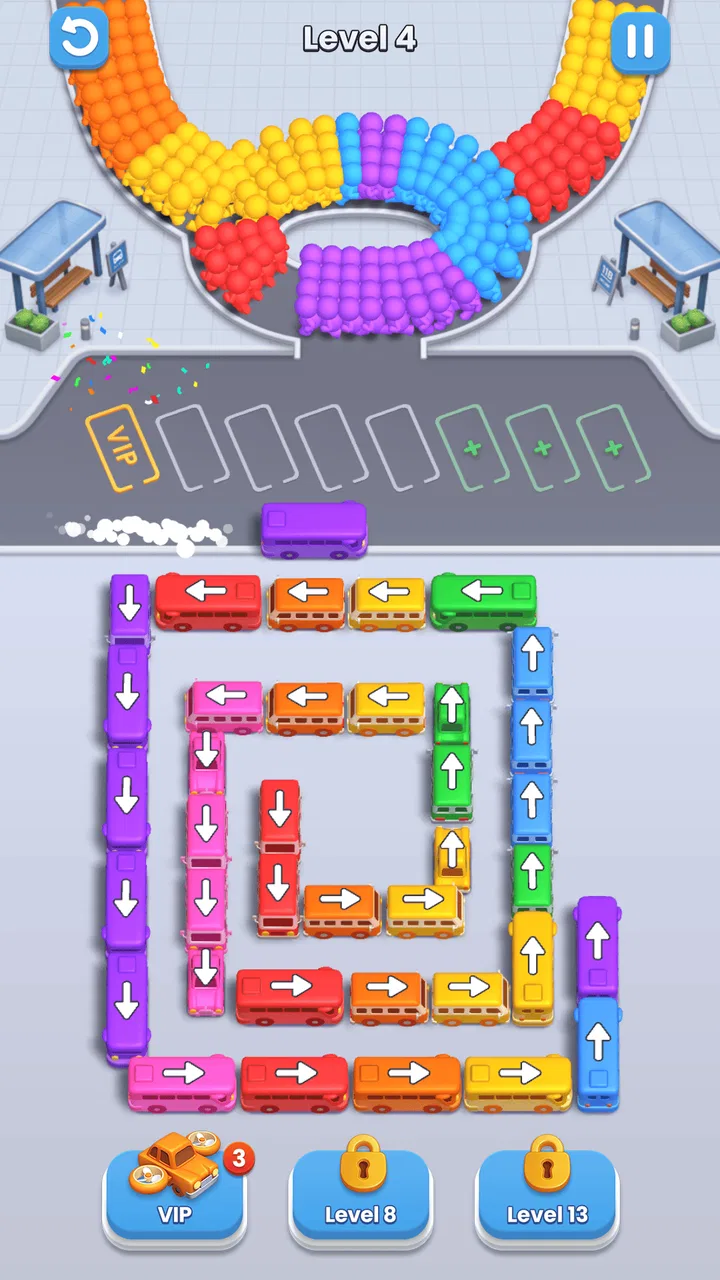
Bus Fever! Car Jam Escape caught my attention because it turns a familiar traffic puzzle into a small, focused bus-sorting challenge. I played it in short sessions rather than treating it like a game that demands a long evening, and that is where its appeal becomes clear: the basic idea is easy to understand, but arranging buses and clearing a jam still gives each level a satisfying moment of concentration. It is a casual game from Lumi Games, available free of charge, with an Everyone age rating and support for devices running Android 8.0 or later.
The first impression is deliberately simple. Buses are caught in a crowded arrangement, and I need to work out the order that lets them leave without making the situation worse. The pleasure comes from spotting the correct sequence before acting, then watching a messy traffic knot become manageable. The store summary describes it as an offline game, and that matters in practice: it fits the kind of quick play I want when I am travelling, waiting for an appointment, or away from a reliable connection.
I would not approach this as a deep simulation of public transport or a strategy game with a large world to explore. Its identity is much narrower and more approachable. It belongs firmly in the casual puzzle game space, where the goal is to offer a compact mental workout without a complicated rulebook. That focus is both its strongest quality and the reason some players may eventually want something more substantial.
You May Also Like

 Pandora - Music & Podcasts
Pandora’s Music Is Easy to Start, but Harder to Recover
Pandora’s strength is its low-effort path from a seed to a station. Its weak spot is how much confidence it asks you to place in connection, setup, and quiet recovery.

 AccuWeather: Weather Radar
AccuWeather Review: A Quick, Clear Forecast for Everyday Decisions
For everyday plans, the best forecast is the one you can understand quickly. AccuWeather makes rain timing, radar, and local conditions easy to act on, with a few trade-offs.

 Hill Climb Racing
Why Hill Climb Racing Still Turns Crashes Into One More Run
A tiny car, a bumpy hill and one more upgrade: Hill Climb Racing keeps resurfacing because its simple chaos makes every near-miss feel personal.

 AliExpress - Shopping App
AliExpress Makes Global Shopping Feel Personal, but Shoppers Bear the Risk
AliExpress turns a global marketplace into a pocket-sized discovery engine. Its reach is useful, its shopping loop compelling, and its trade-offs easy to miss.

 Lords Mobile: Kingdom Wars
Lords Mobile Is a Kingdom-Building Routine, Not a Quick Match
A case-by-case verdict on the building, battles, device demands, and social commitments that make Lords Mobile rewarding for some players and exhausting for others.

 PDF Scanner app - TapScanner
TapScanner Makes Paperwork Easier to Capture, Check, and Share
TapScanner makes scanning with a phone feel less like a rescue operation and more like a dependable step in getting work done. Its capture tools are useful, though not flawless.
More From Our News Desk
View All News


Why the opening sessions work so well
I’ll look at why the opening sessions feel approachable, especially how the bus-jam layout makes the goal clear without asking for much preparation. I’ll also consider the small planning choices that make a simple first puzzle feel more engaging than a quick tap-through.
A clear puzzle loop with almost no learning curve
What worked for me during the first week was how quickly the central task became readable. I did not need a tutorial-heavy introduction or a long explanation of fictional characters and systems. The traffic layout itself communicates the problem. I look at the buses, consider which one can move first, and try to avoid blocking the route needed by the others. That directness makes the game comfortable for people who usually avoid complicated mobile games.
The best early moments come from resisting the urge to move the most obvious bus immediately. A bus that appears ready to leave may be the key to opening space for another vehicle, while a careless move can leave the remaining traffic in an awkward arrangement. This creates a useful little habit: I scan the whole board before touching anything. That habit is more valuable than quick reactions, because the challenge is based on order and foresight rather than speed.
For a game designed around short sessions, that is an effective choice. I can start a level without setting aside a large block of time, and the rules remain understandable even after I have not played for several days. The offline format also makes it suitable for places where I would normally use a basic time-killer, such as a train ride with unreliable service or a queue where I only have a few spare minutes.
The satisfying part is planning, not spectacle
Bus Fever! Car Jam Escape does not need elaborate presentation to make a successful move feel rewarding. The satisfaction comes from solving the arrangement in front of me. When I finally identify the sequence that frees the traffic, the result feels earned because I have mentally tested several possibilities. That makes it more engaging than a passive scrolling app, while still being less demanding than a full strategy title.
One useful approach is to separate buses into three groups in my head: the one that can leave immediately, the one that needs another vehicle moved first, and the one that is currently irrelevant. This simple mental sorting prevents me from wasting moves on vehicles that do not affect the immediate bottleneck. It is a small technique, but it makes difficult layouts feel less random and gives the game more thoughtfulness than its bright, casual presentation might suggest.
Another tip is to pay attention to the narrowest part of the traffic arrangement rather than the most visible bus. The narrow point usually determines whether the board opens smoothly or remains locked. I found that solving the bottleneck first is more reliable than trying to clear vehicles in the order they appear. That kind of observation is where the game offers its most meaningful learning curve.
Who will enjoy the first week
This is a good match for someone who wants a puzzle that can be understood instantly and played in small bursts. It also suits players who like organizing, sequencing, and untangling visual problems without timers or complicated resource systems taking over the experience. Parents looking for an Everyone-rated option may find the presentation approachable, although the actual enjoyment will still depend on whether the player likes repeated logic puzzles.
I would especially recommend it to people who enjoy the feeling of solving a crowded parking or sorting puzzle but want a bus-focused theme. The traffic setting gives the familiar format a clear identity. It is also a sensible choice for an offline library, because I do not have to depend on a connection every time I want a quick level.
By contrast, players seeking competitive matches, a story, character development, or a large collection of different game modes should adjust their expectations. The appeal is the board in front of me, not a broader adventure. If I wanted social competition or a more elaborate progression system, I would choose a different casual title.
What remains after the novelty fades
Once the basic appeal is familiar, the question is whether the game still earns a place in a short-play routine. I’ll focus on what keeps its puzzles useful over time, and on the kinds of players who may find the same focused loop satisfying rather than limiting.
Recurring value depends on the puzzle rhythm
After the initial novelty of moving buses around wore off, I found that the game’s lasting value depended on whether I was still in the mood for the same kind of concentration. The core loop is pleasant because it is compact, but it does not disguise its repetition. I return when I want a quick problem to solve, not because I am following a story or building something over time.
That is not necessarily a weakness. Many casual games are most useful when they occupy a small, dependable place in a daily routine. I can play a few levels during a coffee break, use it to reset my attention after work, or choose it instead of endlessly refreshing social feeds. The game earns repeat visits when I treat it as a short puzzle exercise rather than expecting every session to feel new.
The important trade-off is that its recurring value comes from the quality of the individual traffic layouts. A player who enjoys refining their thinking and finding clean solutions may continue to appreciate that loop. Someone who needs constant new mechanics may feel the experience flatten sooner. In my view, the game has enough immediate clarity to remain useful, but not enough variety to become a universal long-term favorite.
How it compares with familiar alternatives
Compared with match-three games, this one asks for more deliberate planning and less pattern recognition under a changing board. I am not mainly chasing combinations or reacting to a cascade; I am deciding which action preserves future options. Compared with idle games, it offers more active engagement because progress comes from solving the traffic problem rather than waiting for rewards to accumulate.
It also differs from larger parking and sorting games by keeping the bus-jam idea at the center. That makes the experience easier to explain and easier to pick up, but it can also make the content feel more specialized. If I want a relaxing puzzle with a clear visual objective, this focus helps. If I want a broad set of puzzles with several unrelated mechanics, a more expansive alternative may hold my attention longer.
One practical advantage over many connection-dependent mobile games is the offline format. I can use it in situations where an online puzzle may stall, reload, or become inconvenient. The trade-off is that an offline-first experience is less suited to players who want live events, social rankings, or a constantly changing competitive environment. I would choose this game for reliable solo play, not for community features.
Small habits that make harder layouts less tiring
I found three habits particularly useful. First, I avoid committing to the first apparently safe move and instead check what space it creates. Second, I identify the bus or lane that controls the most movement and treat it as the priority. Third, when I make a mistake, I replay the sequence mentally rather than simply tapping faster. These habits reduce frustration because they turn failure into information about the board’s structure.
A fourth approach is to use the game as a deliberate break rather than filling every spare moment with it. When I played while distracted, I made more impulsive moves and enjoyed the puzzles less. When I gave each layout a few seconds of attention, the same simple system felt more rewarding. That tells me the game works best as a light concentration tool, not as background entertainment.
There is also a useful distinction between being stuck and needing patience. Sometimes the correct solution is not difficult to understand; I have simply overlooked a vehicle that should move earlier. Taking a short pause often helps more than repeatedly trying the same sequence. This makes the game a reasonable fit for players who enjoy calm problem-solving, but less appealing to anyone who wants immediate, low-effort rewards every time.
Where the routine can become tiring
A compact puzzle can be easy to return to, but playing the same kind of task repeatedly has a cost. I’ll weigh when the traffic-sorting rhythm remains a welcome mental break and when another casual game might be a better choice for variety or longer sessions.
Repetition is the main long-term pressure
The biggest limitation is the narrowness of the central activity. Sorting buses through traffic is satisfying, but it remains sorting buses through traffic. Once I understood the basic logic, the game’s ability to surprise me depended heavily on the arrangement of each puzzle. If I played for too long in one sitting, the familiar loop became less distinctive and began to feel like a sequence of similar tasks.
That makes session length important. I would rather play briefly and stop while the puzzles still feel crisp than force a long session and turn the game into a chore. It is a title that benefits from being part of a rotation with other games. Used that way, its simplicity is refreshing. Used as my only mobile game, it may not provide enough change for months of continuous attention.
The free-to-play structure is another consideration. The game itself is free, but optional in-app purchases range from $1.99 to $99.99 per item. That broad range means I would pay attention to any purchase prompts and decide in advance whether I want to spend anything. For me, the sensible approach is to enjoy the basic puzzle loop first and avoid treating purchases as part of the normal cost of every session.
Who should skip it
I would skip this game if I know I need a strong narrative reason to keep returning. There are no story expectations I would attach to a traffic-sorting puzzle, and its appeal is not built around character relationships or exploration. I would also look elsewhere if I want multiplayer pressure, competitive rankings, or a simulation with realistic bus routes and passenger management.
Players who dislike repeating similar logic tasks may also lose interest quickly. The game is not trying to be a complete transport management experience, so choosing it with that expectation would lead to disappointment. Likewise, someone who prefers very fast reflex challenges may find the deliberate planning too slow, while someone seeking a completely relaxing experience may find a difficult traffic arrangement unexpectedly demanding.
Device compatibility is straightforward for many Android users because the minimum requirement is Android 8.0. Still, anyone using an older phone or tablet should check compatibility before planning around it. On supported devices, the modest concept feels well suited to casual play, but the real question is not hardware power. It is whether the player enjoys making careful decisions in a crowded visual space.
Maintenance, updates, and everyday fit
Finally, I’ll consider how the game fits around ordinary phone use: its offline suitability, the practical implications of its current release, and the difference between trying it for free and choosing to spend. That should help clarify whether it belongs in a regular rotation or is better kept as an occasional diversion.
A low-maintenance game for an offline routine
From a daily-use perspective, the game is easy to maintain because its purpose is immediately obvious each time I open it. I do not need to remember a complicated build, manage a long list of characters, or reconstruct a story after a break. That makes it a good companion for irregular play. I can leave it alone for a week and return without feeling that I have fallen behind.
The current version is 1.1.9, and the game was released on April 23, 2025. Those details place it among relatively recent casual releases, but I would not judge its long-term value by version numbers alone. What matters to me is whether the existing puzzle loop continues to feel clean and usable. A game like this does not need constant novelty to be worthwhile, but it does need to avoid making short sessions feel unnecessarily demanding.
The developer, Lumi Games, has chosen a concept that is easy to understand across a wide audience. That is a strength for accessibility, although it also raises the bar for puzzle variety: when the rules are simple, repeated layouts and familiar decisions become noticeable quickly. I would keep an eye on how the experience develops over time, while judging the version I can play now on its own merits rather than assuming future additions.
How I would fit it into a real day
Imagine waiting for a delayed appointment with ten minutes to spare. I would open the game, solve a few traffic layouts, and close it without needing sound, a network connection, or a long explanation of what to do next. On a commute, I could use it during a patch of poor reception. At home, I might choose it after work when I want something more active than scrolling but less demanding than a full strategy game.
The same scenario also shows its limit. If I had an entire free evening and wanted a sense of progression, I would probably move to a richer puzzle or simulation game. This one is strongest when it fills a small gap with focused decisions. That is not a minor distinction; it is the key to keeping the game enjoyable after the first week.
Its Everyone rating and free entry point make it easy to try, but I would still think about the purchase model before handing it to a child or using it as a shared family distraction. The puzzle concept is approachable, while optional spending can be a separate concern. I would treat the game as a free casual experience first and make any purchase decision deliberately rather than through an impulsive tap.
My long-term verdict
Bus Fever! Car Jam Escape earns a place on my phone as a compact offline puzzle, not as an all-purpose game. I like the way it turns traffic congestion into a sequence problem that rewards looking ahead. The best sessions leave me feeling that I solved something rather than merely passed time, and the simple controls make it easy to return after a break.
Its average rating is 4.5 from around 8.3 thousand ratings, and it has passed one million installs, which fits the broad appeal I felt during testing. Those figures do not change the central judgment: the game is accessible and easy to start, but its staying power depends on how much I enjoy repeating the same kind of mental task. The free price makes trying it low-risk, while the optional purchase range is worth keeping in mind for anyone who prefers a completely spend-free experience.
My recommendation is strongest for casual players who want short, offline sessions and enjoy planning the order of moves. I would suggest starting with a few brief sessions instead of playing for hours, because the game’s charm is clearest when the puzzles remain fresh. I would not recommend it to someone looking for a story, social competition, deep transport management, or a steady stream of radically different mechanics.
In the end, the game survives the novelty test reasonably well because it has a practical role: it is a quiet, repeatable way to exercise attention for a few minutes. It does not need to dominate my library to be useful. Its lasting value comes from fitting neatly into small gaps in the day, provided I accept the focused format and do not expect it to grow into a much larger experience.
FAQs for Bus Fever Party!
01What is Bus Fever! Car Jam Escape?
Bus Fever! Car Jam Escape is a casual puzzle game focused on clearing crowded roads and parking areas. You guide cars, buses, and other vehicles through traffic by choosing the correct order of movement. Each level requires observation, timing, and planning, since one poorly selected vehicle can block the remaining path and prevent passengers or cars from reaching their destinations.
02How do you play Bus Fever! Car Jam Escape?
The main gameplay is based on tapping or selecting vehicles so they can leave the traffic jam without colliding with obstacles or other vehicles. You need to study the layout, identify which car should move first, and gradually open a route for the others. As levels become more difficult, the game introduces tighter spaces, more vehicles, and additional obstacles that demand careful sequencing.
03Is Bus Fever! Car Jam Escape suitable for beginners?
Yes, the game is generally easy to understand for new players because its controls are simple and the early stages act as a practical introduction. However, the puzzles become progressively more demanding, so beginners should expect to restart some levels while learning the correct order of moves. It is accessible for casual players but still offers a reasonable challenge.
04Does Bus Fever! Car Jam Escape require an internet connection?
The basic puzzle experience may be playable without a continuous internet connection, which makes it convenient for short sessions while traveling or when mobile data is unavailable. Nevertheless, certain features can depend on connectivity, including advertisements, rewards, updates, events, or synchronization. Availability may also vary by version, device, and operating system, so checking the store listing is recommended.
05Are there advertisements or in-app purchases in Bus Fever! Car Jam Escape?
Like many free-to-download casual puzzle games, Bus Fever! Car Jam Escape may include advertising and optional in-app purchases. Ads can appear between levels or when you choose bonus rewards, while purchases may provide extra hints, lives, currency, or other convenience features. You can play without spending money, but users who prefer uninterrupted gameplay should review the current store details before downloading.
Pros
- Simple controls make it easy to start playing immediately.
- Short levels are ideal for quick gaming sessions.
- Colorful visuals make vehicles and puzzles easy to follow.
- Gradually increasing difficulty keeps the gameplay engaging.
- Offline play is convenient when you have no internet access.
Cons
- Later puzzles can feel repetitive after extended play.
- Some levels may depend more on trial and error than strategy.
- Ads can interrupt the game between levels.
- Limited vehicle variety may reduce long-term excitement.
- Mistakes can require repeating parts of a puzzle from the beginning.

Bus Fever Party!
Gallery